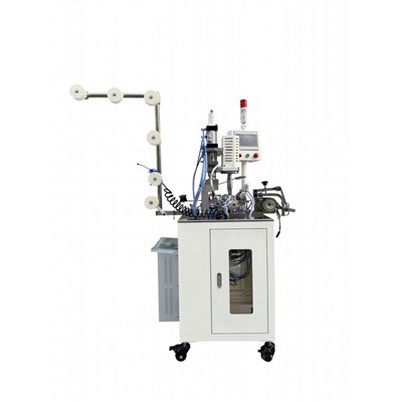
The Scientific Significance Of Nylon Zipper Machines: A Model Of Integration Between Polymer Material Processing And Intelligent Manufacturing
Leave a message
As core equipment for the precision molding of polyamide materials, the nylon zipper machine's scientific significance lies not only in achieving efficient production of nylon zippers, but also in the organic integration of knowledge from multiple disciplines such as polymer materials science, mechanical engineering, automatic control theory, and industrial systems engineering. It provides a typical example of interdisciplinary application in modern manufacturing.
From a materials science perspective, the nylon zipper machine reveals the rheological behavior and phase transition laws of thermoplastic polymers under controlled temperature, pressure, and tension conditions. During extrusion, polyamide chips undergo melting, homogenization, stretching, and shaping. The regulation of molecular chain orientation and crystallinity directly determines the mechanical properties and resilience of the zipper teeth. Through precise temperature control and multi-stage stretching design, the equipment achieves directional shaping of the material's microstructure. This not only verifies the theoretical model of polymer processing science but also provides an experimental and verification platform for the industrial application of novel modified nylon materials.
In the fields of mechanical engineering and precision molding, nylon zipper machines embody the principle of high-consistency manufacturing for complex geometric parts. Zipper tooth forming involves molding or hot pressing processes under high temperature and pressure. The tooth design of the mold, the uniformity of the temperature field, and the efficiency of pressure transmission all require a balance between the rigidity of the mechanical structure and its thermal conductivity. The equipment optimizes the mold and forming unit through a combination of finite element analysis and experimental verification, stabilizing the dimensional tolerance of the zipper teeth at the micrometer level. This demonstrates the feasibility of precision mechanical design at the microscale and promotes the development of micro-forming technology.
The integrated application of automatic control and sensing technologies further expands the scientific connotation of nylon zipper machines. Modern equipment is equipped with closed-loop temperature control, tension monitoring, and online visual inspection systems, enabling real-time perception and correction of processing deviations, forming a dynamic control mechanism with multi-variable coupling. This adaptive processing mode based on feedback control not only improves product consistency but also provides an empirical scenario for the self-optimization algorithm of process parameters in intelligent manufacturing, promoting the application research of industrial big data and artificial intelligence in discrete manufacturing.
From the perspective of systems engineering and sustainable development, nylon zipper machines embody the scientific concept of multi-process collaborative optimization and efficient resource utilization. Through process integration and logistics path optimization, the equipment achieves continuous flow from raw materials to finished products, reducing time and energy consumption in intermediate links. Green designs such as heat recovery and low-waste traction verify the feasibility of industrial systems under energy conservation and emission reduction goals, providing a technical reference for the low-carbon transformation of polymer product manufacturing.
In summary, the scientific significance of the nylon zipper machine lies not only in its function as a production tool but also in its role as a bridge for interdisciplinary technological integration. It integrates controllable molding of polymer materials, micron-level precision machining, real-time feedback from intelligent control, and resource optimization from systems engineering. This deepens the scientific understanding of the material-process-performance relationship and provides a referable theoretical and practical paradigm for the development of intelligent and green manufacturing, highlighting the fundamental driving role of industrial equipment in technological progress.