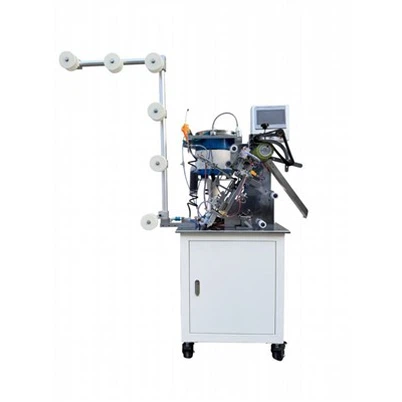
The Functional Foundation Of Metal Zipper Machines: Constructing The Core Process Link in Metal Zipper Manufacturing
Leave a message
The functional foundation of metal zipper machines stems from their systematic decomposition and precise implementation of the entire metal zipper production process. As the core equipment for transforming metal zippers from raw materials to finished products, its functional design revolves around four fundamental stages: tooth forming, tape insertion, zipper head assembly, and quality inspection. These stages are interconnected and work synergistically to form a stable and replicable manufacturing logic.
The primary function is the precise feeding and pre-treatment of metal wire. Through tension control and straightening mechanisms, the equipment conveys coiled metal wire to the processing station at a constant speed and in a flat state, avoiding subsequent forming defects caused by wire bending or tension fluctuations. This stage provides a prerequisite guarantee for the geometric accuracy of tooth processing and is the foundation for ensuring the dimensional consistency of the entire zipper.
The core function lies in the standardized forming of the teeth. Using high-precision stamping dies and cutting units, the metal wire is pressed into a preset tooth shape and cut into tooth blanks of fixed length. The die's tooth parameters (such as tooth height, tooth pitch, and tooth angle) strictly correspond to the target zipper specifications. Combined with the micro-stepping feed of the positioning fixture, micron-level repeatability is achieved, ensuring a high degree of uniformity in the shape and size of each zipper tooth.
A key function also includes the reliable bonding of the zipper teeth to the fabric tape. The equipment, through a fabric tape guide and tooth pushing mechanism, embeds the formed zipper teeth into the fabric tape grooves at a set interval. Then, a hot-pressing or cold-riveting process tightly bonds the root of the zipper teeth to the fabric tape fibers. The pressure, temperature, and time parameters in this process can be precisely controlled, directly determining the zipper's peel strength and lifespan, serving as a crucial link in achieving the desired functionality.
Another fundamental function is the assembly and functional verification of the zipper pull. The equipment uses a vibratory feeder sorting and positioning device to accurately guide the zipper pull into the zipper tooth closing path. Sensors detect the pulling resistance and engagement smoothness, automatically rejecting defective products that are stuck or too loose. This function ensures the reliability of the zippers leaving the factory and is the last line of defense in quality control.
Furthermore, modern metal zipper machines generally integrate process parameter monitoring and data storage functions, capable of recording key data such as tension, pressure, and temperature in real time, providing a basis for process optimization and quality traceability.
Therefore, the functional foundation of a metal zipper machine is not merely the sum of individual actions, but rather supported by precision mechanics and control technology, integrating disparate processes into a closed-loop manufacturing system, thus providing a fundamental guarantee for the stable production and performance compliance of metal zippers.