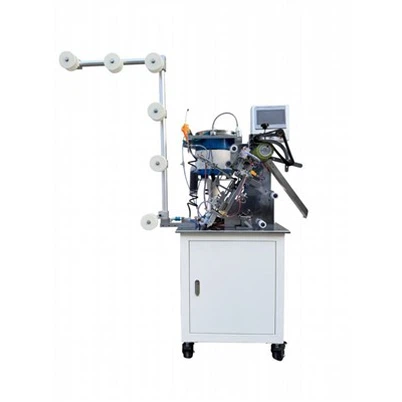
Structural Analysis of Metal Zipper Machines: The Core of Manufacturing Through Precision Collaboration
Leave a message
As a key piece of equipment for achieving large-scale, high-precision production of metal zippers, the metal zipper machine's structural design is based on the core logic of "integrated processes, precise motion, and intelligent control." The collaborative operation of various functional modules constitutes a complete manufacturing chain from metal wire to finished zipper. A deep understanding of its structural components helps in grasping the performance limits and optimization directions of the equipment.
The main structure of a metal zipper machine can be divided into five core modules: feeding system, forming system, insertion system, assembly system, and control system. The feeding system is the starting point of production, typically composed of a servo-driven tension controller and a straightening mechanism. It is responsible for stably conveying the coiled metal wire to the processing station. Its key is to adjust the wire tension through closed-loop feedback to avoid affecting the subsequent forming accuracy due to stretching deformation.
The forming system is the core unit that gives the metal wire the zipper teeth shape, including stamping dies, cutting tools, and positioning fixtures. The mold is designed according to the specifications of the zipper teeth (such as tooth height and tooth pitch), and the wire is pressed into shape through high-frequency impact. The cutting blade simultaneously completes the fixed-length division of the blank. The high-rigidity structure of the positioning fixture ensures the repeatability and precision of the stamping and cutting actions, with errors controllable to the micrometer level.
The insertion system is responsible for combining the zipper teeth with the fabric tape. It consists of a fabric tape guide wheel, a zipper tooth pushing mechanism, and a pressing device. After being flattened by the guide wheel, the fabric tape enters the pushing area. The zipper teeth are pushed into the fabric tape grooves one by one at a preset interval. The pressing device uses a constant-temperature heating or cold-pressing process to tightly bond the zipper teeth to the fabric tape fibers. The force and temperature control in this step directly affect the peel strength of the zipper.
The assembly system focuses on the precise installation and functional testing of the zipper pull, including a zipper pull positioning seat, a closure detection sensor, and a rejection mechanism. After being sorted by a vibratory feeder, the zipper pull enters the positioning seat. After engaging with the zipper teeth, the sensor detects the smoothness of the zipper pull. Defective products are automatically rejected, ensuring that 100% of the products leaving the factory are functionally qualified.
The control system, acting as the "nerve center," is centered around a PLC or industrial computer, integrating a human-machine interface and data monitoring modules. It can adjust the operating parameters of each module in real time and store process curves, providing support for flexible production and quality traceability.
The modules are linked through precision mechanical transmission and electronic signals, forming a seamless connection from raw materials to finished products. This structured design not only ensures the dimensional consistency and performance stability of metal zippers but also establishes their irreplaceable position in high-end manufacturing.